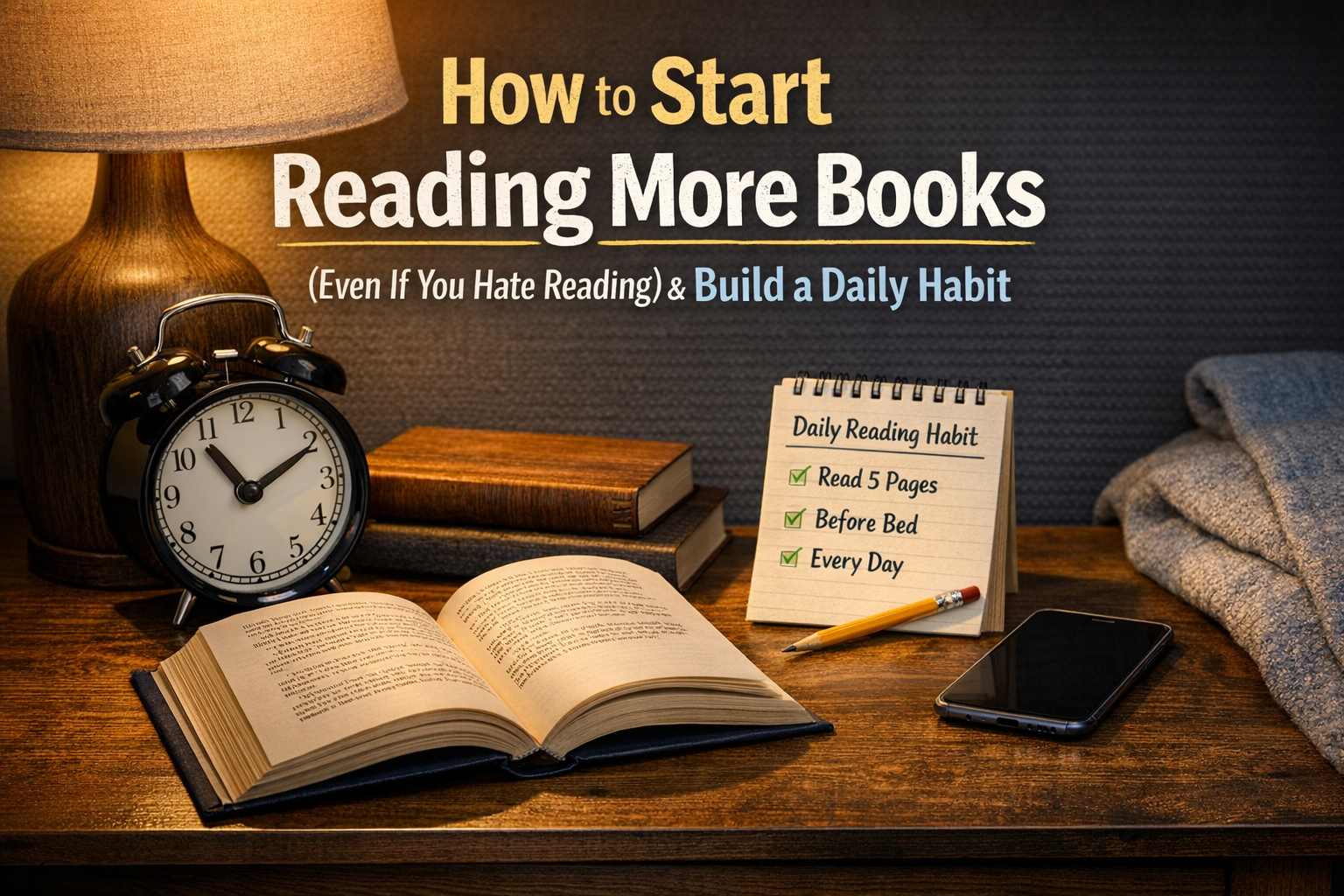
Learn how to start reading more books and build a daily habit—even if you hate reading—with simple, science-backed strategies that actually work.
Why Reading Feels Hard — And How to Change That
You want to read more books.
You’ve bought them. Maybe stacked them on your shelf. Maybe even downloaded a few on your phone.
But somehow… you don’t read.
Or you start and quit.
Or you get bored.
Or you tell yourself, “I’m just not a reader.”
If that sounds familiar, you’re not alone.
According to a 2023 Pew Research study, 23% of adults in the U.S. didn’t read a single book in the past year. At the same time, research from the American Psychological Association shows that reading for just 6 minutes can reduce stress levels by up to 68%. That’s more effective than listening to music or going for a walk.
So the issue isn’t whether reading is valuable.
The issue is this:
How do you start reading more books—and actually build a daily habit—especially if you hate reading?
In this guide, you’ll learn:
- Why you dislike reading (and how to fix it)
- How to make reading easier and more enjoyable
- A simple framework to build a daily reading habit
- A real-life example of someone who went from “non-reader” to finishing 24 books a year
- Practical tools and systems that remove friction
Let’s begin.
Why You Hate Reading (And Why That’s Not Your Fault)
Before you learn how to start reading more books, you need to understand something important:
Most people don’t hate reading.
They hate how they were introduced to reading.
For many of us, reading was:
- Forced in school
- Tied to exams
- Boring or outdated
- Disconnected from our interests
When reading feels like a chore, your brain resists it.
There’s also a modern challenge: attention fragmentation.
A 2022 Microsoft study found the average human attention span has dropped to around 8 seconds, partly due to digital overload. Social media, notifications, and short-form content have trained our brains to expect quick rewards.
Books require sustained attention. That feels uncomfortable at first.
But here’s the good news:
Attention is trainable.
Reading is a skill—not a personality trait.
You are not “bad at reading.”
You just haven’t built the habit yet.
How to Start Reading More Books (Even If You Hate It)
Let’s make this practical.
If you truly want to know how to start reading more books, start by removing friction.
Step 1: Choose the Right Book (Not the “Impressive” One)
Stop choosing books to look smart.
Choose books that make you curious.
If you enjoy:
- Crime shows → Try thrillers or true crime
- Business podcasts → Read productivity or finance books
- Romance movies → Try contemporary romance novels
- Self-improvement content → Start with short motivational books
Interest beats discipline.
Step 2: Start Small (Ridiculously Small)
Most people fail because they aim too high.
Instead of:
“I’ll read 30 minutes daily.”
Try:
“I’ll read 5 pages.”
That’s it.
Five pages feels easy. Easy builds momentum.
Research from Stanford behavior scientist BJ Fogg shows that tiny habits are more sustainable than ambitious goals. Small actions create identity shifts over time.
Step 3: Make Reading Convenient
The easier something is, the more likely you’ll do it.
Try this:
- Keep a book on your pillow
- Carry a book in your bag
- Download an eBook app
- Use audiobooks during commutes
Friction kills habits. Convenience builds them.
Step 4: Give Yourself Permission to Quit
Yes, quit.
If a book is boring after 50–100 pages, stop reading it.
Life is short. There are millions of books.
Forcing yourself to finish bad books reinforces the idea that reading is painful.
How to Build a Daily Reading Habit That Actually Sticks
Now let’s talk about habit formation.
Reading occasionally is easy.
Reading daily requires a system.
Here’s a simple framework:
The 4-Step Daily Habit Formula
- Trigger – Attach reading to something you already do
Example: After brushing your teeth → read 5 pages - Make it Easy – Keep the book visible
- Set a Tiny Goal – 5–10 pages
- Track Progress – Use a checklist or habit app
Why This Works
Habits are formed through repetition and reward loops.
According to a 2009 study from University College London, it takes an average of 66 days to form a habit. That doesn’t mean perfection. It means consistency.
Reading daily—even 10 minutes—adds up.
10 minutes per day =
70 minutes per week =
60+ hours per year.
That’s enough to finish 20–30 books annually.
Case Study: From “I Hate Reading” to 24 Books a Year
Let’s look at a real example.
Case: Rahul, 29, Software Developer
Rahul hadn’t finished a book in 7 years. He believed reading was boring and slow.
Here’s what changed:
What He Did:
- Switched from non-fiction to fantasy novels
- Started reading 5 pages before bed
- Deleted social media apps during weekdays
- Tracked progress in a notebook
- Joined a small online reading group
Results After 12 Months:
- Finished 24 books
- Reported improved focus at work
- Reduced screen time by 40%
- Used reading as a stress-management tool
The key?
He didn’t force intensity.
He built a daily habit.
The Hidden Benefits of Reading (That Motivate You to Continue)
When you understand the benefits, motivation increases.
Here are evidence-backed advantages:
- Reading improves empathy (University of Toronto research)
- Regular readers show slower cognitive decline with age (Neurology Journal study)
- Reading fiction improves emotional intelligence
- Reading before bed improves sleep quality compared to screens
And remember:
Reading reduces stress by 68%, according to Sussex University research.
When you build a daily reading habit, you’re not just finishing books.
You’re upgrading your brain.
Practical Action Plan (Start Today)
Here’s your simple starting checklist:
- Choose 1 interesting book
- Set a 5-page daily goal
- Attach reading to bedtime
- Track for 30 days
- Replace 10 minutes of scrolling with reading
Don’t aim for perfection.
Aim for consistency.
Conclusion: Start Small, Stay Consistent
You don’t need to love reading today.
You just need to start.
If you want to know how to start reading more books and build a daily habit, remember:
- Choose interesting books
- Start tiny
- Remove friction
- Track progress
- Stay consistent for 60+ days
Reading isn’t about finishing 100 books.
It’s about becoming someone who reads.
And that identity starts with 5 pages tonight.
Your Action Step:
Pick one book right now. Read 5 pages before bed. Repeat tomorrow.
That’s how habits begin.
Frequently Asked Questions (FAQ)
1. How long should I read daily as a beginner?
Start with 5–10 minutes or 5 pages. Increase gradually after 2–3 weeks.
2. What if I get bored while reading?
Switch books. You’re allowed to quit boring ones.
3. Are audiobooks as effective as physical books?
Yes. Studies show comprehension levels are similar for most adults.
4. How many books should I aim to read per year?
Start with 12 books (1 per month). Increase once the habit feels natural.
5. What’s the best time to read?
Before bed or right after waking up—when distractions are lowest.
