
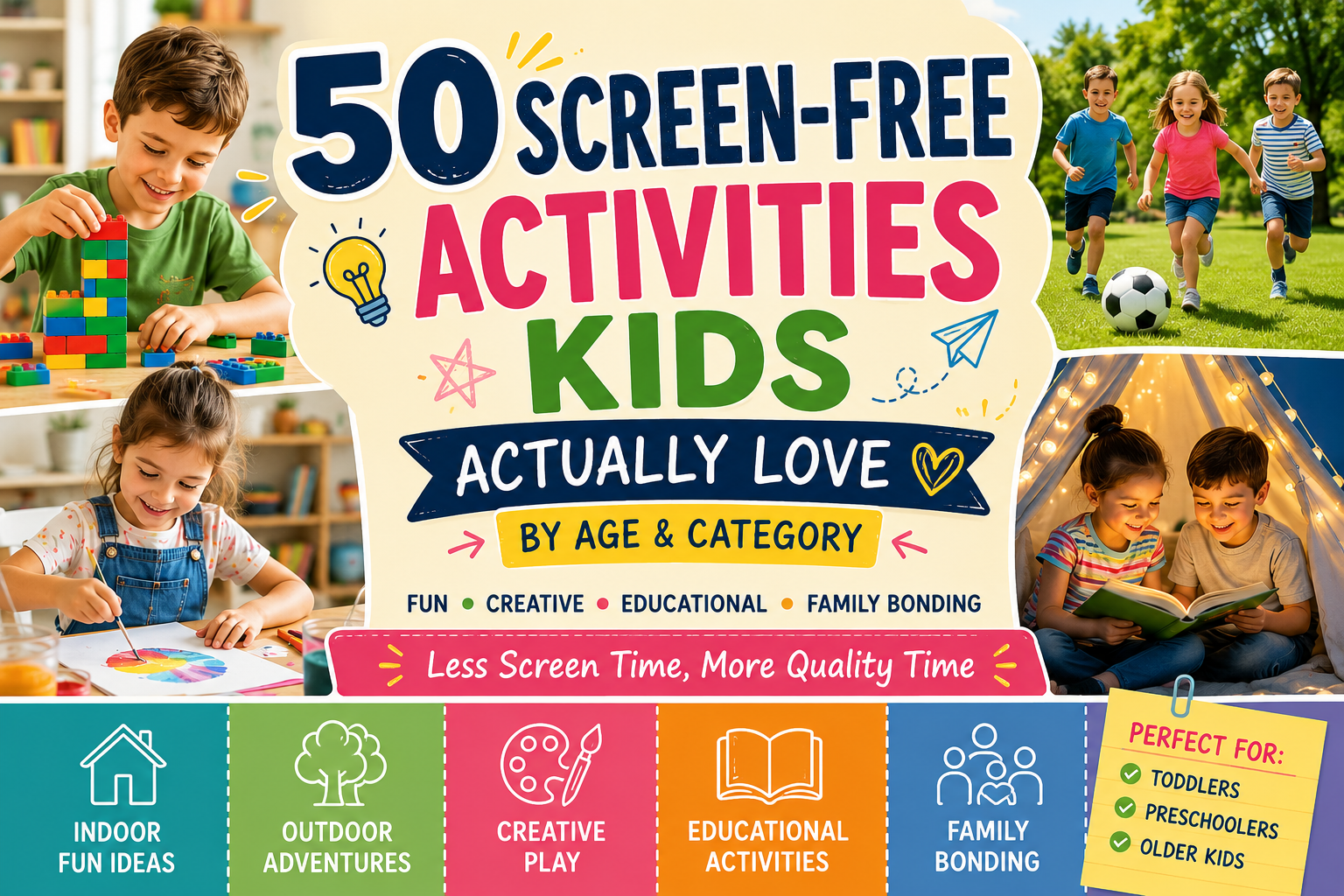
Discover 50 Screen-Free Activities Kids Actually Love, organized by age and category to boost creativity, learning, and family bonding at home.
In today’s digital world, screens are everywhere—phones, tablets, TVs, and computers often dominate a child’s daily routine. While technology has its benefits, too much screen time can affect sleep, attention span, emotional development, and family connection.
That’s why many parents are now searching for Screen-Free Activities Kids Actually Love—fun, engaging, and meaningful ways to keep children entertained without relying on devices.
This guide brings together 50 practical, creative, and age-appropriate screen-free activities that encourage imagination, learning, and stronger parent-child bonding. Whether you’re a busy parent, teacher, or caregiver, these ideas will help you replace screen time with quality time.
We’ll explore:
- Activities by age group
- Indoor and outdoor ideas
- Creative and educational play
- Family bonding activities
- Real-life examples of screen-free success
Let’s dive in.
Why Screen-Free Activities Matter for Kids
In today’s digital-first lifestyle, children are exposed to screens earlier than ever before. While technology has educational benefits, excessive usage can negatively affect a child’s development, behavior, and emotional health.
That’s why Screen-Free Activities Kids Actually Love are becoming a top priority for modern parents.
Research shows that children who engage regularly in screen-free play develop stronger attention spans, better social skills, and improved creativity. According to child development experts, hands-on experiences help children retain information far better than passive screen viewing.
Another important reason to encourage Screen-Free Activities Kids is emotional bonding. When parents actively participate in offline play, children feel more secure, valued, and emotionally connected.
Key benefits include:
- Improved focus and concentration
- Better sleep patterns
- Reduced anxiety and overstimulation
- Stronger parent-child relationships
- Enhanced creativity and imagination
Simply reducing screen time by even 30–60 minutes a day and replacing it with screen-free activities for kids at home can create noticeable improvements in behavior and happiness.
Screen-Free Activities for Toddlers (Ages 2–4)
Toddlers are naturally curious, energetic, and eager to explore the world through touch, sound, and movement. At this stage, the best Screen-Free Activities Kids Actually Love are simple, sensory-based, and safe.
Toddlers learn best through repetition and hands-on interaction, so screen-free play should focus on stimulation rather than structure.
Here are expanded ideas:
1. Sensory Play Bins
Fill a container with rice, beans, or sand and hide small toys inside.
2. Shape Sorting Games
Use household objects to teach shapes and colors.
3. Water Play Activities
Let toddlers pour, scoop, and splash safely.
4. Simple Building Blocks
Encourage stacking and building towers.
5. Story Time with Actions
Read books and act out characters together.
Tip: Keep activities short (10–15 minutes) to match attention span.
Parents searching for Screen-Free Activities Kids at toddler age often struggle with short attention spans. The key is to rotate activities frequently and keep them under 10–15 minutes.
These early screen-free activities for toddlers are essential because they build foundational cognitive and emotional skills that last a lifetime.
Screen-Free Activities for Preschool & Early Kids (Ages 4–7)
Preschool and early school-age children are highly imaginative and love interactive play. This is the perfect stage to introduce structured yet fun Screen-Free Activities Kids Actually Love that also support learning.
At this age, children begin developing storytelling skills, problem-solving abilities, and social awareness.
Expanded activity ideas include:
- Imaginative role-play games (doctor, teacher, shopkeeper)
- Indoor scavenger hunts with clues and rewards
- Creative craft sessions using paper, glue, and recycled materials
- Puzzle-solving challenges to improve critical thinking
- Cooking simple recipes with parent supervision
- Story-building games where each family member adds a sentence
These screen-free activities for kids at home not only reduce screen dependency but also strengthen early learning skills.
When parents actively engage in Screen-Free Activities Kids, children are more likely to develop curiosity and independent thinking.ination and early learning skills.
Screen-Free Activities for Older Kids (Ages 8–12)
Older children require more engaging, skill-based, and challenge-driven activities. At this stage, Screen-Free Activities Kids Actually Love should feel exciting, not forced.
They are more independent, so activities should encourage creativity, logic, and teamwork.
Expanded ideas include:
1. DIY Science Experiments
Try volcano experiments, slime making, or simple physics tricks.
2. Journaling or Story Writing
Encourage creativity through writing stories or daily journals.
3. Outdoor Sports
Football, cycling, badminton, or skipping rope.
4. Board Games & Strategy Games
Chess, Scrabble, or Monopoly.
5. Building Projects
LEGO challenges or cardboard engineering.
6. Cooking Challenges
Let kids prepare simple recipes.
These types of screen-free activities for kids help improve decision-making, patience, and analytical thinking.
Parents often notice that replacing even one hour of screen time with Screen-Free Activities Kids Actually Love significantly improves focus and reduces behavioral issues.
Family Bonding Screen-Free Activities
Family bonding is one of the most powerful benefits of reducing screen time. Shared offline experiences help build trust, communication, and emotional connection.
That’s why Screen-Free Activities Kids Actually Love should always include family participation.
Expanded ideas:
- Weekly family game nights without devices
- Cooking meals together as a team activity
- Outdoor picnics and nature walks
- “Story exchange” evenings where each member shares a story
- Gratitude circles to reflect on the day
- DIY home improvement or craft projects together
Families that regularly practice screen-free activities for kids at home often report stronger relationships and improved communication.
Even small routines like 30 minutes of daily Screen-Free Activities Kids can transform family dynamics over time.
Case Study Example
A study conducted on family habits found that families who spend at least 30–60 minutes daily in screen-free interaction report stronger emotional bonding and improved communication among children.
For example, one working parent introduced a “screen-free hour” every evening where the family played board games or cooked together. Within a month, the parent noticed improved behavior, better sleep patterns, and more open communication with their child.
Outdoor Screen-Free Activities Kids Love
Outdoor play is essential for physical and mental health.
Ideas:
- Nature scavenger hunts
- Gardening and planting seeds
- Bicycle rides
- Park obstacle courses
- Kite flying
- Chalk drawing on pavements
- Outdoor sports tournaments
- Bug and insect observation
Outdoor activities also help reduce stress and improve focus in children.
Creative and Educational Screen-Free Activities
These activities combine fun with learning.
Educational Play Ideas:
- Alphabet scavenger hunt
- Math games using objects (like counting toys)
- DIY flashcards
- Reading challenge games
- Simple science experiments
- Origami crafts
- Music and rhythm games
Creativity-based activities help children develop critical thinking and problem-solving skills.
Conclusion
Reducing screen time doesn’t mean removing fun—it means replacing it with meaningful, engaging experiences.
These 50 Screen-Free Activities Kids Actually Love are designed to help parents create stronger bonds, encourage creativity, and support healthy development in children of all ages.
Start small. Even replacing 30 minutes of screen time per day with interactive play can make a big difference.
Call-to-Action
Try introducing just one screen-free activity today and observe the difference in your child’s mood, focus, and happiness. Consistency is the key to lasting change.
Frequently Asked Questions (FAQs)
1. Why are screen-free activities important for kids?
They improve creativity, social skills, attention span, and emotional development.
2. How much screen time is safe for children?
Experts recommend no more than 1 hour per day for young children and balanced usage for older kids.
3. What are the best indoor screen-free activities?
Board games, crafts, storytelling, puzzles, and pretend play are excellent options.
4. How can I reduce my child’s screen time?
Start gradually, introduce fun alternatives, and set consistent screen-free routines.
5. Do screen-free activities really improve behavior?
Yes, studies show improved focus, mood, and communication in children with reduced screen exposure.
