
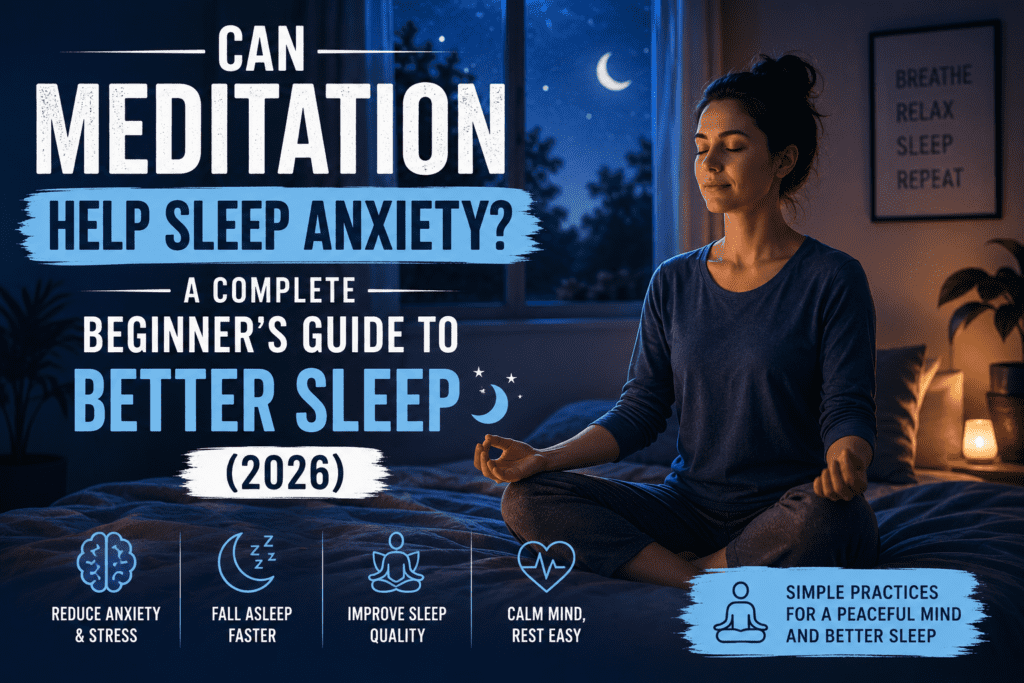
Meditation help sleep anxiety guide explaining how mindfulness reduces stress, improves relaxation, and supports better sleep for beginners in 2026.
Why Sleep Anxiety Is So Common—and How Meditation Can Help
Sleep anxiety has become one of the most widespread modern wellness challenges. In 2026, with constant digital stimulation, irregular work patterns, and rising stress levels, many people find themselves exhausted yet unable to sleep. The mind races, the body stays alert, and bedtime becomes a source of frustration rather than rest.
This is where meditation enters the picture—not as a quick fix, but as a practical, evidence-supported method to calm the nervous system and improve sleep quality over time.
In this guide, we’ll explore whether meditation can help sleep anxiety, how it works biologically, and how beginners can use it effectively. You’ll learn:
- What sleep anxiety actually is and why it happens
- How meditation affects the brain and sleep cycle
- The best meditation techniques for beginners
- A step-by-step routine to start tonight
- Real-world examples and science-backed insights
- Common mistakes and how to avoid them
By the end, you’ll have a clear, actionable system for using meditation to support better sleep without needing complicated tools or expensive treatments.
Understanding Meditation Help Sleep Anxiety and Why Sleep Anxiety Happens
Sleep anxiety is not just “trouble sleeping.” It’s a cycle of worry about not sleeping that ironically makes sleep even harder to achieve.
When you lie in bed thinking “I need to fall asleep now”, your brain activates a stress response. Instead of winding down, your nervous system shifts into alert mode.
What happens in the body:
- Cortisol (stress hormone) increases
- Heart rate stays elevated
- Brain waves remain active instead of slowing down
- Melatonin release becomes inconsistent
This creates a loop:
Worry about sleep → increased alertness → inability to sleep → more worry
Common triggers of sleep anxiety
- Overthinking at bedtime
- Work or academic stress
- Screen exposure before sleep
- Irregular sleep schedule
- Past insomnia episodes
Key statistic insights
Research in sleep medicine suggests:
- Around 30–40% of adults experience occasional insomnia symptoms
- Nearly 10–15% suffer from chronic insomnia
- Stress-related sleep disruption is one of the leading causes of poor sleep quality globally
- Evening screen exposure can delay sleep onset by up to 90 minutes in sensitive individuals
These numbers highlight how widespread the issue is—and why non-pharmaceutical approaches like meditation are gaining attention.
How Meditation Help Sleep Anxiety and Improves Better Sleep
Meditation is not just relaxation—it actively changes how the brain responds to stress.
When you practice meditation, especially mindfulness or breath-focused techniques, you train your nervous system to shift from a “fight or flight” state into a “rest and digest” state.
Brain and body changes during meditation
- Reduced activity in the amygdala (fear and stress center)
- Increased activation of the prefrontal cortex (emotional regulation)
- Lower cortisol levels
- Improved heart rate variability (a marker of relaxation)
What research shows
Studies in sleep psychology and neuroscience have found:
- Mindfulness meditation can reduce insomnia symptoms by up to 50% in some participants
- Regular meditation may improve sleep quality scores within 2–8 weeks of practice
- Participants often report reduced sleep latency (time to fall asleep)
- Meditation improves overall sleep efficiency by stabilizing sleep cycles
Why it works for sleep anxiety specifically
Sleep anxiety is rooted in anticipation and mental overactivity. Meditation interrupts this pattern by:
- Redirecting attention away from intrusive thoughts
- Slowing down breathing patterns
- Creating a psychological “buffer zone” between stress and sleep
In simple terms:
Meditation doesn’t force sleep—it removes the mental barriers that prevent it.
Best Types of Meditation for Better Sleep and Relaxation
Not all meditation styles are equally effective for sleep anxiety. Some are better for focus, others for relaxation.
Here are the most effective techniques:
1. Mindfulness Meditation
Focus: Present moment awareness
- Observe thoughts without judgment
- Focus on breath or bodily sensations
- Let thoughts pass without engagement
Best for: Racing thoughts at bedtime
2. Body Scan Meditation
Focus: Physical relaxation
Steps:
- Slowly bring attention from head to toe
- Notice tension in each body part
- Release tension gradually
Best for: Physical restlessness and muscle tension
3. Guided Sleep Meditation
Focus: External voice guidance
- Audio-led relaxation
- Visualization techniques
- Progressive calming instructions
Best for: Beginners who struggle with silence
4. Breathing-Based Meditation
Focus: Controlled breathing patterns
Example techniques:
- 4-7-8 breathing
- Box breathing (4-4-4-4 rhythm)
Best for: Immediate anxiety reduction
5. Visualization Meditation
Focus: Mental imagery
- Imagine peaceful environments (beach, forest, clouds)
- Engage all senses mentally
- Replace anxious thoughts with calming imagery
Best for: Overthinking at night
Quick comparison list:
- Fast anxiety relief → Breathing meditation
- Deep relaxation → Body scan
- Beginner-friendly → Guided meditation
- Long-term benefits → Mindfulness practice
Step-by-Step Beginner Guide to Using Meditation for Sleep Anxiety
Starting meditation doesn’t require experience or special equipment. Consistency matters more than duration.
Step 1: Set a simple environment
- Dim lights
- Reduce noise
- Put phone on silent or sleep mode
Step 2: Choose a short session (5–10 minutes)
Beginners often quit because they aim for too long. Start small.
Step 3: Focus on breathing
Try this simple pattern:
- Inhale for 4 seconds
- Hold for 4 seconds
- Exhale for 6 seconds
Repeat gently.
Step 4: Acknowledge thoughts without resistance
If thoughts appear:
- Don’t fight them
- Don’t analyze them
- Let them pass like clouds
Step 5: Transition into sleep naturally
After meditation:
- Stop actively trying to sleep
- Keep eyes closed
- Let the body drift naturally
Simple nightly routine example
- Turn off screens (30–60 minutes before bed)
- Light stretching (2–5 minutes)
- Meditation (10 minutes)
- Quiet breathing in bed
Common mistakes to avoid
- Expecting instant sleep every time
- Using meditation only when extremely anxious
- Practicing inconsistently
- Judging thoughts during meditation
Real Case Study, Lifestyle Integration, and Long-Term Results
Case Study: “Emma’s 6-Week Sleep Reset”
Emma, a 32-year-old marketing professional, struggled with sleep anxiety for over a year. She reported lying awake for 1–2 hours each night, worrying about work deadlines and poor sleep performance.
Her initial situation:
- Sleep onset time: ~90 minutes
- Frequent nighttime awakenings
- High evening anxiety levels
Her meditation routine:
- 10 minutes guided meditation before bed
- 5-minute breathing exercise in bed
- Consistency: 6 days per week
Results after 6 weeks:
- Sleep onset reduced to ~20–30 minutes
- Reduced nighttime awakenings
- Reported calmer bedtime mindset
- Improved daytime focus and energy
Key takeaway from her experience:
Consistency mattered more than duration. Even short sessions created measurable change over time.
How to combine meditation with lifestyle habits
Meditation works best when paired with supportive sleep habits:
- Limit caffeine after mid-afternoon
- Keep a consistent sleep schedule
- Reduce screen exposure at night
- Exercise regularly (but not too late)
- Create a comfortable sleep environment
Long-term benefits of meditation for sleep
- Improved emotional regulation
- Reduced stress reactivity
- More stable sleep cycles
- Lower risk of chronic insomnia symptoms
- Better overall mental clarity
Conclusion
Yes—meditation can significantly help reduce sleep anxiety, especially when practiced consistently.
It doesn’t act as a sedative. Instead, it trains your mind and body to exit stress mode naturally, making sleep easier and more sustainable.
The key takeaways:
- Sleep anxiety is driven by mental overactivity and stress cycles
- Meditation reduces physiological and psychological arousal
- Different techniques work for different needs
- Consistency is more important than duration
- Benefits build gradually over weeks
Call-to-action
Start tonight with just 5 minutes of breathing meditation. You don’t need perfection—only repetition. Over time, your brain learns a new pattern: bedtime becomes calm, not stressful.
Frequently Asked Questions (FAQs)
1. How long does meditation take to improve sleep anxiety?
Most people notice improvements within 2–8 weeks of consistent practice.
2. Can meditation replace sleep medication?
It can support sleep quality, but it should not replace prescribed medication without medical guidance.
3. What is the best time to meditate for sleep?
Evening, ideally 30–60 minutes before bed, works best for sleep-focused meditation.
4. Do I need silence to meditate?
No. Guided meditation or soft background sounds can also be effective.
5. What if my mind keeps wandering during meditation?
That is normal. The goal is not to stop thoughts but to notice and return attention gently.
