
Discover the best Hip Thrust Alternative Exercises you can do at home to maximize Glute Growth, build strength, and achieve better lower-body results.
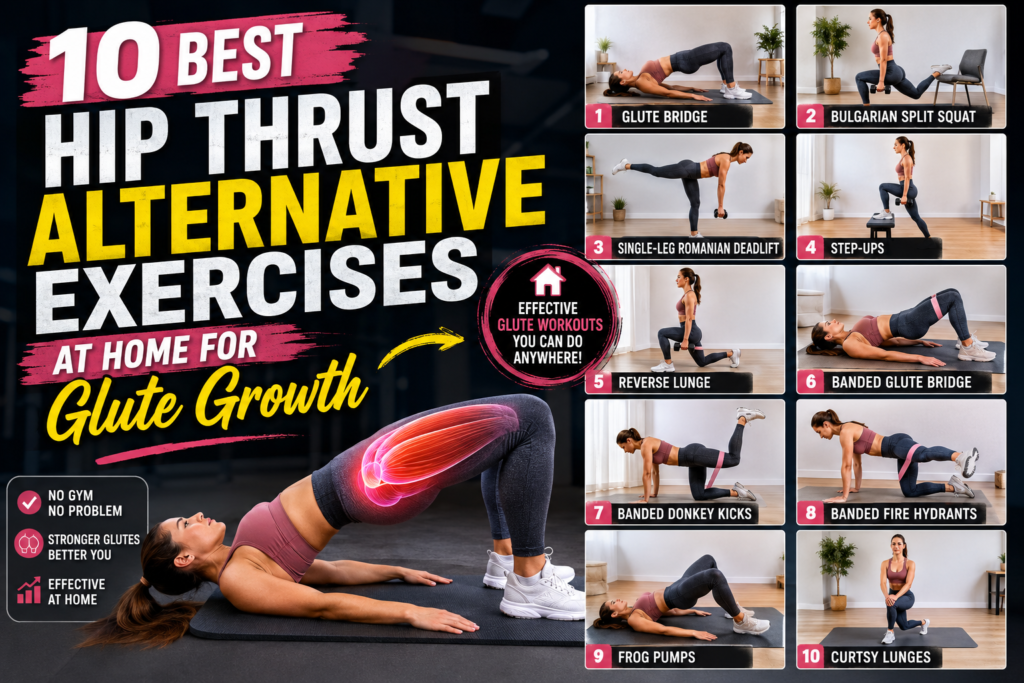
Building strong, well-developed glutes is a goal for many fitness enthusiasts. While hip thrusts are widely considered one of the most effective glute-building exercises, not everyone has access to the equipment, space, or setup required to perform them comfortably at home.
The good news? You don’t need a barbell, bench, or gym membership to achieve impressive glute growth. There are numerous Hip Thrust Alternative Exercises that can effectively target the glute muscles, improve lower-body strength, and help create balanced muscle development from the comfort of your home.
In this guide, you’ll discover the 10 best alternatives to hip thrusts, learn how they stimulate glute growth, understand proper exercise selection, and see how to build an effective at-home glute workout routine.
Whether you’re a beginner, recovering from injury, training in a small apartment, or simply looking to add variety to your workouts, these exercises can help you continue making progress.
Why Hip Thrust Alternatives Can Still Deliver Excellent Glute Growth
Hip thrusts have become popular because they place significant tension on the gluteus maximus through a large range of motion. However, they are not the only exercise capable of stimulating muscle growth.
Research consistently shows that muscle hypertrophy is primarily driven by:
- Mechanical tension
- Progressive overload
- Adequate training volume
- Proper recovery
- Nutritional support
As long as these factors are present, multiple exercises can contribute significantly to glute growth.
Key Statistics About Glute Training
- Adults can lose approximately 3% to 8% of muscle mass per decade after age 30 if strength training is neglected.
- The gluteus maximus is the largest muscle in the human body.
- Most fitness organizations recommend at least 2 strength-training sessions per week for major muscle groups.
- Research suggests that training a muscle group 2-3 times weekly often produces superior hypertrophy results compared to once-weekly training.
- Progressive resistance training has been shown to significantly improve both muscle size and strength across various populations.
These findings highlight that consistent resistance training matters more than relying on a single exercise.
Understanding the Muscles Responsible for Glute Growth
Before selecting Hip Thrust Alternative Exercises, it’s helpful to understand the muscles you’re trying to develop.
Gluteus Maximus
The largest and most visible glute muscle. It is responsible for:
- Hip extension
- Running
- Jumping
- Climbing stairs
- Squatting
Gluteus Medius
Located on the outer hip, this muscle helps:
- Stabilize the pelvis
- Improve balance
- Enhance athletic performance
Gluteus Minimus
The smallest glute muscle that assists with:
- Hip stabilization
- Leg movement control
- Postural support
The best glute training programs target all three muscles rather than focusing solely on hip extension movements.
10 Best Hip Thrust Alternative Exercises at Home
1. Glute Bridge
The glute bridge is perhaps the closest alternative to the hip thrust.
How to Perform It
- Lie on your back.
- Bend your knees.
- Place feet flat on the floor.
- Drive through your heels.
- Lift your hips upward.
- Squeeze your glutes at the top.
Why It Works
The movement pattern closely mimics the hip thrust and effectively targets the gluteus maximus.
Progression
- Single-leg glute bridge
- Weighted glute bridge
- Banded glute bridge
2. Bulgarian Split Squat
This exercise creates significant glute activation while also strengthening the quadriceps.
How to Perform It
- Place one foot behind you on a chair or couch.
- Lower your body slowly.
- Push through your front heel to return.
Why It Works
The deep hip flexion position places the glutes under substantial tension, making it excellent for glute growth.
3. Single-Leg Romanian Deadlift
This unilateral exercise improves balance while targeting the posterior chain.
Benefits
- Strong glute engagement
- Improved stability
- Better athletic performance
- Reduced muscle imbalances
Tips
Keep your back flat and hinge at the hips rather than bending through the spine.
4. Step-Ups
A simple household step or sturdy platform can become an effective glute-training tool.
Execution
- Place one foot on a step.
- Drive through the working leg.
- Lift your body upward.
- Lower under control.
Why It Works
The glutes work hard to extend the hip and stabilize the pelvis.
5. Reverse Lunges
Reverse lunges are often easier on the knees than forward lunges.
Benefits
- Improved glute recruitment
- Enhanced balance
- Functional lower-body strength
- Minimal equipment required
To increase glute emphasis, take a slightly longer step backward.
Resistance Band Exercises for Enhanced Glute Growth
Resistance bands are affordable, portable, and highly effective for creating muscular tension.
6. Banded Glute Bridge
Adding a resistance band above the knees increases glute medius activation.
Key Benefits
- Improved hip stability
- Greater muscle recruitment
- Increased exercise difficulty
7. Banded Donkey Kicks
This movement isolates the glutes effectively.
How to Perform
- Begin on all fours.
- Place a resistance band around your feet.
- Kick one leg backward.
- Squeeze the glute at full extension.
Common Mistake
Avoid arching your lower back.
8. Banded Fire Hydrants
Fire hydrants primarily target the gluteus medius.
Benefits
- Better hip stability
- Improved athletic movement
- Enhanced side-glute development
Strong side glutes contribute significantly to overall glute shape and aesthetics.
Bodyweight Movements That Build Strong Glutes
Bodyweight exercises are often underestimated. However, strategic programming can make them highly effective.
9. Frog Pumps
Frog pumps create an intense glute contraction with minimal setup.
Instructions
- Lie on your back.
- Bring the soles of your feet together.
- Push hips upward.
- Pause and squeeze.
Why They Work
The position minimizes hamstring involvement, increasing glute emphasis.
10. Curtsy Lunges
Curtsy lunges target both the glute maximus and glute medius.
Benefits
- Improved lower-body coordination
- Enhanced hip stability
- Better glute development
Form Tip
Maintain an upright torso and controlled movement throughout the exercise.
Example Home Workout for Maximum Glute Growth
To get the most from these Hip Thrust Alternative Exercises, structure them into a complete routine.
Beginner Workout
| Exercise | Sets | Reps |
|---|---|---|
| Glute Bridge | 3 | 15 |
| Reverse Lunge | 3 | 10 per side |
| Frog Pumps | 3 | 20 |
| Fire Hydrants | 3 | 15 per side |
Intermediate Workout
| Exercise | Sets | Reps |
| Bulgarian Split Squat | 4 | 10 |
| Single-Leg Romanian Deadlift | 4 | 10 |
| Step-Ups | 4 | 12 |
| Banded Glute Bridge | 4 | 15 |
| Donkey Kicks | 3 | 20 |
Train 2-3 times weekly while gradually increasing resistance or repetitions.
Case Study: Sarah’s At-Home Glute Transformation
Sarah, a 34-year-old marketing professional, wanted to improve her lower-body strength but had no gym access.
Instead of relying on hip thrusts, she focused on:
- Bulgarian split squats
- Glute bridges
- Reverse lunges
- Resistance band exercises
Over 12 weeks she consistently trained three times per week, increased resistance gradually, and maintained a high-protein diet.
Results included:
- Noticeably stronger glutes
- Improved posture
- Better balance
- Increased lower-body strength
- Greater workout consistency due to convenience
Her experience demonstrates that glute growth depends more on consistency and progressive overload than any single exercise.
Common Mistakes That Limit Glute Growth
Many people perform the right exercises but fail to see results because of common training errors.
1. Lack of Progressive Overload
Gradually increase:
- Repetitions
- Sets
- Resistance
- Time under tension
2. Poor Exercise Form
Improper technique shifts work away from the glutes.
3. Insufficient Recovery
Muscles grow during recovery, not during training.
4. Neglecting Protein Intake
Protein supports muscle repair and growth.
5. Inconsistent Training
Long-term consistency beats short bursts of intense effort.
How to Accelerate Glute Growth at Home
For the best results:
Prioritize Compound Movements
Exercises like split squats and lunges recruit more muscle fibers.
Train Frequently
Aim for 2-3 glute-focused sessions weekly.
Focus on Mind-Muscle Connection
Actively squeezing the glutes can improve muscle activation.
Use Tempo Training
Slow the lowering phase to increase muscular tension.
Track Progress
Record:
- Reps
- Sets
- Resistance used
- Body measurements
- Progress photos
Tracking helps ensure continual improvement.
Conclusion
Hip thrusts may be popular, but they are far from your only option for building stronger, more developed glutes. The best Hip Thrust Alternative Exercises can effectively stimulate Glute Growth while requiring little to no equipment.
Exercises such as glute bridges, Bulgarian split squats, reverse lunges, frog pumps, step-ups, and resistance band movements provide excellent opportunities to challenge the glutes from multiple angles and movement patterns.
Remember that successful glute development comes down to consistency, progressive overload, proper nutrition, and recovery. By incorporating these 10 exercises into your weekly routine, you can build stronger glutes and improve overall lower-body performance without ever stepping into a gym.
Ready to start growing your glutes at home? Choose 4-5 exercises from this list, create a simple weekly routine, and commit to consistent training for the next 8-12 weeks. Your results may surprise you.
Frequently Asked Questions
1. Can I build glutes without doing hip thrusts?
Yes. Many exercises such as Bulgarian split squats, glute bridges, reverse lunges, and Romanian deadlifts effectively stimulate glute growth.
2. How often should I train glutes for maximum growth?
Most people benefit from training glutes 2-3 times per week with adequate recovery between sessions.
3. Are bodyweight exercises enough for glute growth?
Beginners can achieve excellent results with bodyweight exercises. As strength improves, adding resistance bands or weights can enhance progress.
4. Which exercise is the closest alternative to hip thrusts?
The glute bridge is generally considered the closest movement pattern to the hip thrust.
5. How long does it take to see glute growth?
Many individuals begin noticing strength improvements within 4-6 weeks and visible muscle changes within 8-12 weeks, depending on training consistency and nutrition.
