
Learn how to stop procrastinating and focus on your goals with proven strategies, habits, and science-backed techniques to boost productivity and stay consistent.
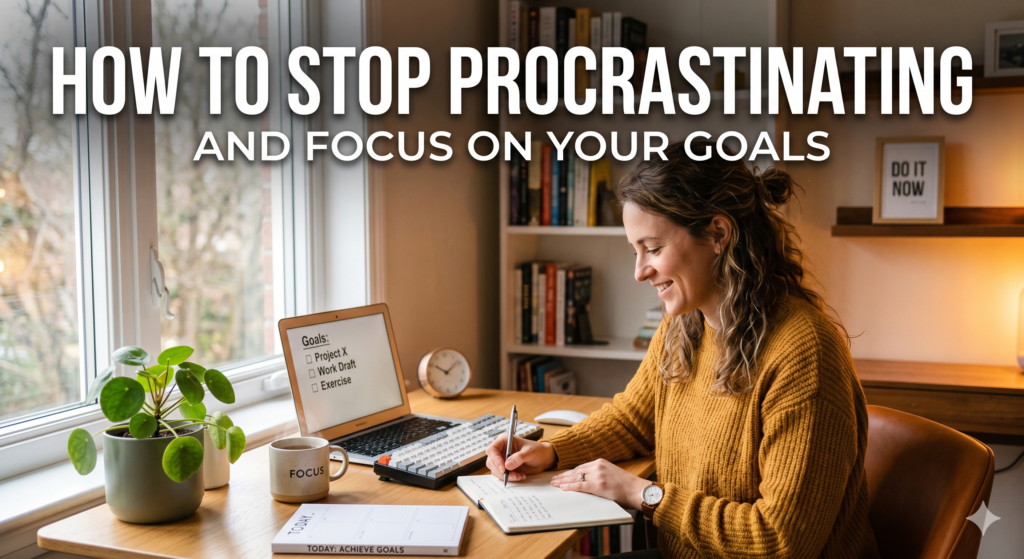
If you are searching for how to stop procrastinating and focus on your goals, you are not alone. Millions of people struggle daily with delaying important tasks, losing focus, and feeling unmotivated even when they know exactly what they need to do.
The truth is simple: procrastination is not a time problem—it is a behavior and mindset problem.
In this guide, you will learn practical, science-backed methods on how to stop procrastinating, improve focus, and consistently move toward your goals even when motivation is low.
We will cover:
- Why procrastination happens
- How to stop procrastinating step-by-step
- How to focus on your goals daily
- How to build habits that remove resistance
- Real-life examples and proven systems
By the end, you will have a clear system to stop delaying and start achieving.
Why You Struggle to Stop Procrastinating
Before learning how to stop procrastinating, you must understand why it happens.
Most people think procrastination is laziness. In reality, it is emotional avoidance.
When you try to focus on your goals, your brain often reacts with:
- Fear of failure
- Fear of discomfort
- Overwhelm from big tasks
- Lack of clarity
- Low energy or motivation
- Perfectionism
So instead of working, your brain chooses short-term relief (social media, entertainment, distractions).
This cycle becomes automatic over time. You don’t even realize you are avoiding important work—you just feel “stuck” or “not in the mood.”
The Real Reason You Can’t Focus on Your Goals
Your brain is designed to protect you from discomfort. That means anything difficult or uncertain feels like a threat, even if it is beneficial in the long run.
This is why learning how to stop procrastinating is really about training your emotional response, not just your schedule.
Until you learn to act despite discomfort, you will continue to struggle to focus on your goals consistently.
Step 1: Break Your Goals Into Tiny Actions
One of the most effective ways to stop procrastinating and focus on your goals is to break everything into micro-actions.
Big goals create fear. Small actions create movement.
When a task feels too large, your brain automatically delays it. But when it feels simple, you start immediately.
Example:
Instead of:
- “Start my business”
Break it into:
- Write 3 business ideas
- Research one competitor
- Create a simple homepage draft
Instead of:
- “Get fit”
Break it into:
- Put on workout clothes
- Do a 10-minute walk
- Do light stretching
Why This Works
Small actions reduce mental resistance and trick your brain into starting. Once you start, momentum takes over.
This is one of the fastest psychological tricks for learning how to stop procrastinating instantly.
Progress always begins with clarity and simplicity.
Step 2: Use the 5-Minute Rule to Build Focus
If you want to truly focus on your goals, you must overcome the hardest part: starting.
The 5-minute rule works by removing pressure completely.
You tell yourself:
“I will do this for just 5 minutes.”
Nothing more.
Why this method is powerful:
- Eliminates fear of long work sessions
- Reduces mental resistance
- Makes starting effortless
- Builds natural momentum
Once you begin, your brain shifts from resistance to engagement. In most cases, you will continue far beyond 5 minutes without forcing yourself.
This is one of the simplest yet most effective strategies for anyone learning how to stop procrastinating in daily life.
Step 3: Remove Distractions Before You Start
You cannot consistently focus on your goals in an environment designed for distraction.
Most procrastination is not internal—it is environmental.
Every notification, app, or interruption pulls your attention away and resets your focus cycle.
Digital distractions:
- Social media notifications
- Messaging apps
- Endless browsing tabs
- YouTube autoplay
Physical distractions:
- Cluttered desk
- Noise
- Unorganized workspace
- Phone within reach
The solution:
Before starting work, prepare your environment like a “focus zone.”
Remove anything that is not related to your task.
When distractions are gone, your ability to stop procrastinating naturally increases without extra effort.
Step 4: Build a Daily System to Focus on Your Goals
Motivation is temporary. Systems are permanent.
If you want long-term success in how to stop procrastinating and focus on your goals, you need structure.
Without a system, every day becomes a decision-making battle. With a system, your actions become automatic.
Simple daily system:
- Identify 3 important tasks
- Start with the hardest task first
- Work in focused time blocks
- Take short breaks between sessions
- Review your progress at the end of the day
Why systems work:
They reduce decision fatigue. You don’t waste mental energy deciding what to do next—you just follow the structure.
This consistency is what separates productive people from those who constantly struggle to focus on their goals.
Step 5: Train Discipline Instead of Waiting for Motivation
If you want to master how to stop procrastinating, you must understand one truth:
Motivation is unreliable. Discipline is stable.
People wait to “feel ready,” but readiness rarely comes.
How to build discipline:
- Do small tasks even when you feel lazy
- Show up daily regardless of mood
- Keep promises to yourself
- Focus on action, not feelings
Every time you act without motivation, you strengthen discipline.
Over time, your identity shifts from “someone who procrastinates” to “someone who takes action.”
This identity change is the foundation of learning to truly focus on your goals long-term.
Case Study: How One Student Learned to Focus on His Goals
Let’s look at a real-life style example.
A student struggling with exams constantly said he wanted to focus on his goals, but he kept procrastinating.
His problems:
- Studying only last minute
- Spending hours on phone
- No study schedule
What he changed:
- Broke study into 30-minute sessions
- Used phone blocker apps
- Studied first thing in morning
- Used 5-minute start rule
Results after 3 weeks:
- Studied consistently every day
- Reduced stress before exams
- Improved grades
- Learned how to stop procrastinating naturally
The key lesson: small systems create big results.
How to Stay Consistent and Focus on Your Goals Long-Term
Many people learn how to stop procrastinating, but fail to stay consistent.
Here’s how to fix that:
1. Track progress daily
Seeing progress builds motivation.
2. Celebrate small wins
Every completed task matters.
3. Avoid perfectionism
Done is better than perfect.
4. Review weekly goals
Adjust and improve every week.
5. Stay accountable
Tell someone your goals.
Powerful Techniques to Stop Procrastinating Fast
Here are quick methods to stop procrastinating immediately:
- Start with easiest task
- Use timer (Pomodoro technique)
- Change location
- Remove phone completely
- Write “just start” reminder
- Break tasks into smallest steps
These techniques help you regain focus instantly.
Why Most People Fail to Focus on Their Goals
People fail not because goals are hard, but because they:
- Wait for motivation
- Don’t plan properly
- Get distracted easily
- Fear failure
- Overthink too much
If you want to focus on your goals, you must act before you feel ready.
Conclusion
Learning how to stop procrastinating and focus on your goals is not about perfection—it is about action.
If you remember only a few things from this guide, remember this:
- Start small
- Remove distractions
- Build systems, not motivation
- Take action immediately
- Stay consistent over time
You don’t need a perfect plan. You need a starting point.
The moment you begin applying these steps, you will notice a shift in how you think, act, and achieve your goals.
Start today. Not tomorrow.
FAQs
1. How do I stop procrastinating immediately?
Start with a small 5-minute task. Action reduces resistance instantly.
2. Why can’t I focus on my goals?
Most people struggle due to distractions, lack of clarity, and emotional avoidance.
3. Can procrastination be fixed?
Yes, it can be changed through habits, systems, and consistent action.
4. What is the fastest way to improve focus?
Remove distractions and use time-blocking techniques.
5. How long does it take to stop procrastinating?
It depends, but consistent habits can show improvement in 2–4 weeks.
